Nigerian Agritech Entrepreneur Wins $100,000 to Expand AI-Powered Solar Farms
Smart Israel’s Smartel Agri Tech combines artificial intelligence, solar energy and hydroponic farming to address food insecurity, water scarcity and climate-related agricultural challenges.
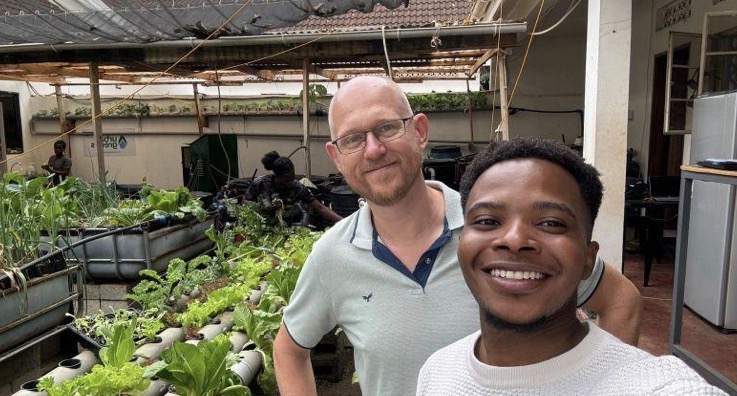
A Nigerian agritech entrepreneur, Smart Israel, has won a $100,000 international award for developing an agricultural technology that could help communities facing food insecurity, water scarcity and the growing effects of climate change.
Israel, the founder and Chief Executive Officer of Smartel Agri Tech, was named the winner of the 2026 Global Citizen Waislitz Grand Prize, an award recognising individuals developing innovative solutions to challenges associated with extreme poverty.
His innovation combines artificial intelligence (AI), solar energy and hydroponic farming to enable communities to grow food without relying on traditional soil-based agricultural methods.
The award will support the expansion of Smartel’s operations, with the company aiming to reach an additional 5,000 households through affordable climate-smart food production.
Turning agricultural challenges into technological opportunities
Israel’s interest in developing alternative farming systems is rooted in his experiences growing up in Nigeria’s Middle Belt, where he witnessed how resource conflicts, displacement and climate change contributed to hunger and malnutrition in vulnerable communities.
These experiences influenced his decision to establish Smartel, a climate-technology enterprise focused on making food production possible in environments where conventional agriculture is difficult.
Traditional farming often depends on access to fertile land, sufficient water and favourable weather conditions. However, these resources are increasingly threatened by environmental changes, land degradation and population pressures.
Smartel seeks to address some of these challenges through hydroponics, a method of growing plants without soil by supplying their roots with water containing essential nutrients.
Its systems are designed to operate using solar energy and technology that monitors important growing conditions, including temperature, humidity, light intensity and nutrient levels.
The company also integrates artificial intelligence and machine learning to interpret agricultural data and provide farmers with information that can improve crop management.
How the Farm-in-a-Box technology works
One of Smartel’s innovations is its Hydroponic Farm-in-a-Box, a compact farming system designed to make food production possible in locations with limited agricultural space.
The technology uses vertically arranged growing structures to maximise available space while circulating nutrient-rich water to plants.
By combining hydroponics with solar-powered equipment and digital monitoring systems, the innovation allows farmers to produce vegetables without depending entirely on conventional farmland or grid electricity.
According to information published by Smartel, its systems can reduce water consumption by more than 90 per cent compared with traditional farming methods.
The company also reports that its technology can increase crop yields by approximately 30 per cent and reduce input costs by 40 per cent.
These performance figures are company-reported estimates, but they demonstrate the potential benefits of integrating technology into agricultural production.
The approach could be particularly useful in urban settlements, dry regions and communities where access to fertile land and reliable water supplies is limited.
Over 3,000 systems deployed to support food production
Smartel has reportedly deployed more than 3,000 hydroponic systems, helping thousands of farmers and households gain access to sustainable food production.
The company’s work extends beyond the installation of agricultural equipment. Its model also incorporates community training, agricultural education and opportunities for smallholder farmers to adopt modern production techniques.
The organisation aims to establish community hydroponic hubs that can serve as local centres for food production, knowledge sharing and agricultural innovation.
These hubs are particularly important for communities affected by displacement and climate-related disruptions, where conventional agricultural activities may be difficult to sustain.
By enabling households and small-scale farmers to produce fresh vegetables within limited spaces, the model offers an alternative approach to improving local food availability.
What the $100,000 award means for the initiative
The Global Citizen Waislitz Awards are presented annually by Global Citizen and the Waislitz Foundation to recognise individuals whose work contributes to addressing extreme poverty.
The 2026 edition featured three winners, each receiving $100,000 to expand their respective initiatives.
Israel received the Grand Prize for Smartel’s contribution to food security and climate-resilient agriculture.
According to the organisers, the funding will help the company reach an additional 5,000 households with affordable farming solutions while expanding its community hydroponic hub model.
The recognition also places a Nigerian agricultural innovation on an international platform, highlighting the potential of locally developed technology to address challenges affecting communities across different regions.
A possible direction for Africa’s agricultural future
Africa continues to face significant food security challenges, with climate change, water scarcity, limited agricultural infrastructure and economic pressures affecting food production.
For countries such as Nigeria, where agriculture remains an important source of employment and livelihood, improving productivity while reducing environmental pressure is increasingly important.
Innovations such as Smartel’s hydroponic systems demonstrate how artificial intelligence and renewable energy can complement traditional agricultural knowledge.
However, the wider adoption of these technologies will depend on affordability, access to technical support, reliable maintenance and the ability of smallholder farmers to integrate them into existing agricultural systems.
The development also highlights the importance of investing in African entrepreneurs who are building solutions around challenges within their own communities.
For Smartel, the next phase involves taking its technology to more households and strengthening the community-based model behind its operations.
As food security becomes an increasingly urgent global concern, innovations that make agricultural production more accessible, efficient and climate-resilient could play an important role in shaping the future of food systems.
Follow AfriView
Don’t Miss the Next Big Story
Enjoyed this story? Stay connected with AfriView for the latest breaking news, trending stories and important updates from Nigeria, Africa and around the world.