Nigeria’s Stock Market Gains ₦2.64 Trillion in One Day: What Does It Mean for Investors?
Nigeria's equities market reached a record ₦163.16 trillion on October 26, driven partly by gains in industrial stocks, but the rally does not mean every investor made money.
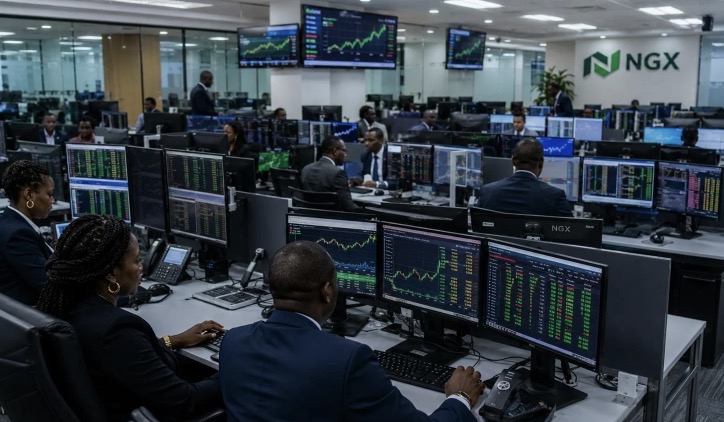
Nigeria's stock market recorded a significant rise on Monday, October 26, as total equity market capitalisation increased by ₦2.64 trillion in a single trading session.
Market capitalisation rose from approximately ₦160.52 trillion on Friday, October 23, to ₦163.16 trillion on Monday, according to figures published for the Nigerian Exchange (NGX).
The NGX All-Share Index, which tracks the overall performance of listed equities, also climbed by 4,068.27 points, or 1.65 per cent, to close at 251,290.54 points.
The figures put the market at a new reported high, continuing a period of strong movement in Nigerian equities.
But while the headline numbers may attract attention, the important question for ordinary Nigerians is what this increase actually represents and whether it translates into gains for individual investors.
What pushed the market higher?
Industrial stocks played a major role in Monday's rally.
Dangote Cement rose by 10 per cent to close at ₦1,222.10 per share, while Honeywell Flour Mills gained 9.78 per cent to reach ₦19.65.
The Nigerian Exchange Group also recorded an increase, rising by 8.20 per cent to close at ₦165 per share.
These movements helped lift the value of the market, particularly as large companies can have a substantial influence on overall market capitalisation.
The All-Share Index also advanced, suggesting that the session's performance was not limited to the increase in the value of a single company.
However, not every listed stock recorded gains. ABC Transport, Caverton Offshore Support Group and Livestock Feeds were among the decliners reported for the session.
This difference matters because a rising overall index does not mean all companies are performing well at the same time.
Does this mean Nigerians are getting richer?
Not necessarily.
Market capitalisation measures the combined market value of listed shares. It can increase when share prices rise, even though the companies have not necessarily received new cash equivalent to the increase in their market value.
For example, if a company's share price rises, the market value of all its outstanding shares generally rises as well. That does not mean every shareholder has sold shares at the higher price or received money directly from the increase.
Investors who already own shares in companies whose prices rise may see the value of their holdings increase. Those who do not own those shares may not benefit directly.
The stock market's performance also does not automatically translate into higher wages, cheaper food, lower transport costs or improved purchasing power for households.
Those outcomes depend on broader economic conditions, including employment, inflation, business investment and income growth.
Why investors should look beyond the headline
A one-day rally can be encouraging, but it is only one part of the market's overall performance. Investors need to consider why share prices are rising, whether companies are generating sustainable earnings, and how their valuations compare with expected profits.
They should also consider their personal financial circumstances, investment horizon and ability to absorb losses.
Buying a share simply because its price has risen sharply can expose an investor to the risk of purchasing at an unfavourable price if market sentiment subsequently changes.
Similarly, a rise in market capitalisation should not be treated as evidence that every listed company has become more profitable.
The market's subsequent performance will depend on company results, investor sentiment, interest rates, economic conditions and other developments that influence demand for equities.
Monday's increase establishes a notable market milestone, but it does not determine what will happen in the next trading session.
For investors and observers, the more useful approach is to monitor the market over time, examine individual company fundamentals and distinguish between rising share prices and improvements in the wider economy.
Nigeria's stock market has delivered a substantial one-day increase. Whether that momentum continues is a separate question.
Follow AfriView
Don’t Miss the Next Big Story
Enjoyed this story? Stay connected with AfriView for the latest breaking news, trending stories and important updates from Nigeria, Africa and around the world.