JUST IN: Spain Train Disaster Kills 69 as Ukraine Ceasefire Ends, Germany Faces Protests and Gaza Strikes
69 killed in Spain train disaster as fresh developments emerge from Ukraine, Germany and Gaza.
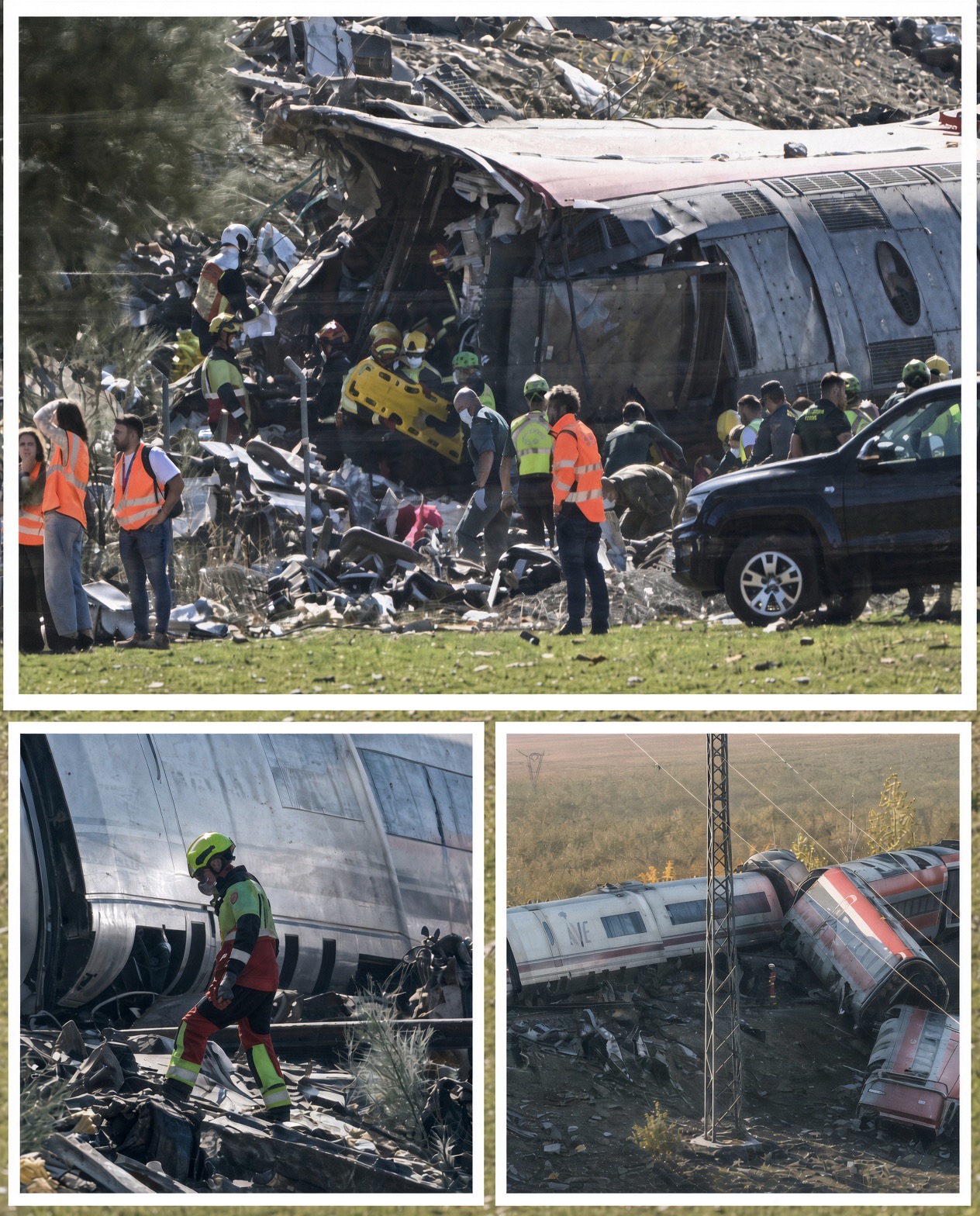
Spain is mourning after a devastating high-speed train collision killed 69 people, including four Americans, while fresh developments in Ukraine, Germany and Gaza highlight growing security and humanitarian concerns across different parts of the world.
Spain Mourns 69 Victims After Deadly High-Speed Train Collision
Spain is observing a period of national mourning following a devastating high-speed train collision near Urda in Toledo province that claimed 69 lives and left dozens of others injured.
The accident, which happened on Wednesday, October 28, 2026, involved two high-speed trains travelling along the Madrid-to-Seville railway corridor.
According to reports, a train operated by Spain’s state railway company Renfe crashed into the rear of a stationary train belonging to private operator Iryo.
The collision caused several carriages to derail, leaving passengers trapped inside severely damaged sections of the trains.
Emergency responders, firefighters, police officers and medical personnel were immediately deployed to the scene to rescue survivors and recover victims.
The disaster became one of Europe’s deadliest railway accidents in recent years, prompting renewed questions about railway safety and the management of Spain’s high-speed transport network.
Authorities confirmed that 69 people died in the accident.
Among the victims were four American citizens, alongside nationals from Canada, Japan, Argentina, Mexico, Tunisia, the Czech Republic, France and Portugal.
Spanish forensic authorities reported on November 2 that 66 of the 69 victims had been formally identified, with three identification cases still outstanding.
The identification process involved fingerprint analysis and DNA testing, while families continued receiving official notifications.
The tragedy has also attracted international attention because of the number of foreign nationals affected.
Questions Raised Over Railway Safety
The circumstances surrounding the collision have placed Spain’s railway safety procedures under serious scrutiny.
Preliminary information indicated that a technical failure affected a railway safety system along a 63-kilometre section of track.
The failure reportedly caused several trains to stop.
However, a central control centre subsequently authorised the Renfe train to resume its journey while the Iryo train remained stationary further along the track.
Spain’s Transport Minister, Óscar Puente, described the decision as inexplicable and said investigators needed to establish how the train was allowed to continue.
Railway unions have also raised concerns about working conditions, staffing levels and the pressure placed on railway control personnel.
The government has promised a thorough investigation, while affected families are demanding answers about how the disaster happened.
The collision has become particularly sensitive because Spain experienced another deadly high-speed railway accident in January 2026, when 46 people died in a separate collision in southern Spain.
The two accidents have intensified public discussions about infrastructure maintenance, signalling systems and passenger safety.
Ukraine’s Localized Ceasefire Ends in Kherson Region
Meanwhile, developments in Ukraine have raised fresh concerns about civilians living near the front lines following the expiration of a localized ceasefire in the Kherson region.
The temporary ceasefire around the Russian-occupied town of Oleshky was established to allow humanitarian assistance and civilian evacuations.
The six-day arrangement provided an opportunity for civilians to leave dangerous areas, while humanitarian teams worked to improve access to essential supplies.
According to reports, hundreds of residents were evacuated during the temporary pause in fighting.
Reuters reported that 167 civilians, including 22 children and 21 people with limited mobility, were evacuated from threatened areas on Sunday.
The operation also involved clearing roads and supporting humanitarian movements.
The ceasefire was particularly significant because it provided a rare opportunity for cooperation involving parties connected to the conflict.
However, the arrangement was temporary, and concerns have emerged over the possibility of renewed fighting following its expiration.
Residents in the region remain vulnerable to artillery attacks, drone operations and other military activities.
Russian strikes have also continued in other parts of Ukraine.
Ukrainian President Volodymyr Zelenskyy has warned about attacks on energy infrastructure, which have affected electricity supplies as the country prepares for winter.
The developments demonstrate how difficult it remains to establish lasting humanitarian arrangements in areas affected by the war.
Germany Faces Unrest After Youth-Led Protests Turn Violent
Germany has also experienced significant unrest following youth-led demonstrations across several cities over economic difficulties, education, public services and proposed military service changes.
The demonstrations, organised under the campaign group Gen Z regelt, attracted thousands of young people and other supporters.
Protesters expressed concerns about the rising cost of living, inadequate educational facilities, public spending and the future of young people in Germany.
Although many demonstrations were peaceful, violence broke out in several locations, particularly Frankfurt.
Authorities reported smashed shop windows, damaged buildings, burning barricades and clashes between demonstrators and security personnel.
Some businesses were reportedly looted during the disturbances.
Police officers were also injured as security forces attempted to control the situation.
In Frankfurt, authorities reported that 54 people had been arrested, while more than 100 police officers were injured.
Cologne and Berlin also experienced disturbances.
The organisers of the demonstrations distanced themselves from the violence, insisting that their campaign supported peaceful demonstrations and democratic participation.
The protests reflect wider concerns among young Europeans about economic opportunities, housing affordability, education and government policies.
Similar demonstrations have also taken place in France, where hundreds of thousands of people participated in protests over living costs and public services.
The situation has placed additional pressure on European authorities to address the concerns driving public demonstrations while maintaining public order.
Gaza Faces More Israeli Strikes Despite Ceasefire Arrangements
In the Middle East, fresh Israeli military strikes have reportedly killed Palestinians in different locations across the Gaza Strip, raising renewed concerns about the durability of the ceasefire arrangements.
According to Reuters, Israeli strikes on Monday, November 2, killed at least three Palestinians and wounded several others.
Medical officials reported that two people were killed in separate attacks in Khan Younis, while another person died in an attack in Al-Mussadar.
The Israeli military said it had conducted strikes targeting Palestinian militants.
However, Hamas has denied accusations that it is rebuilding its military capabilities or violating the ceasefire.
The continuing violence has raised questions about the implementation of the US-brokered agreement, which was intended to create conditions for reconstruction and a reduction in hostilities.
Negotiations have reportedly encountered difficulties over issues including Hamas disarmament and the withdrawal of Israeli forces.
Meanwhile, humanitarian conditions remain extremely difficult for Gaza’s population.
More than two million people live in the territory, where widespread destruction has damaged homes, hospitals, infrastructure and essential services.
The latest developments demonstrate that the ceasefire has not completely stopped violence or resolved the wider conflict.
International attention remains focused on efforts to protect civilians, improve humanitarian access and establish a more lasting political settlement.
International Concerns Grow Over Security and Humanitarian Challenges
The developments in Spain, Ukraine, Germany and Gaza highlight several challenges facing different parts of the world.
Spain is demanding answers following a railway disaster that claimed 69 lives.
Ukraine continues to face military threats despite temporary humanitarian arrangements in parts of its territory.
Germany is dealing with public unrest driven by economic and political concerns among younger generations.
Meanwhile, Gaza continues to experience deadly violence despite ceasefire arrangements intended to reduce hostilities.
Although these events have different causes, they share an important concern: the safety, welfare and security of ordinary people.
Governments and international organisations face increasing pressure to respond effectively, protect civilians and prevent further loss of life.
Conclusion
The November 2 international developments present a difficult picture of global security and humanitarian conditions.
Spain remains in mourning following its devastating high-speed train collision, while Ukraine faces uncertainty after the expiration of its localized ceasefire.
Germany is working to contain unrest following youth-led demonstrations, and Gaza continues to experience deadly attacks despite efforts to maintain a ceasefire.
As investigations, diplomatic discussions and security operations continue, the international community will be watching closely for further developments.
Afriview Media will continue monitoring these stories and providing updates as verified information becomes available.
Follow AfriView
Don’t Miss the Next Big Story
Enjoyed this story? Stay connected with AfriView for the latest breaking news, trending stories and important updates from Nigeria, Africa and around the world.