Dangote Acquires Nearly 25% Stake in Kenya Pipeline Company
The acquisition gives the Nigerian industrialist a major position in Kenya’s fuel distribution network as his business interests expand into East Africa’s energy market.
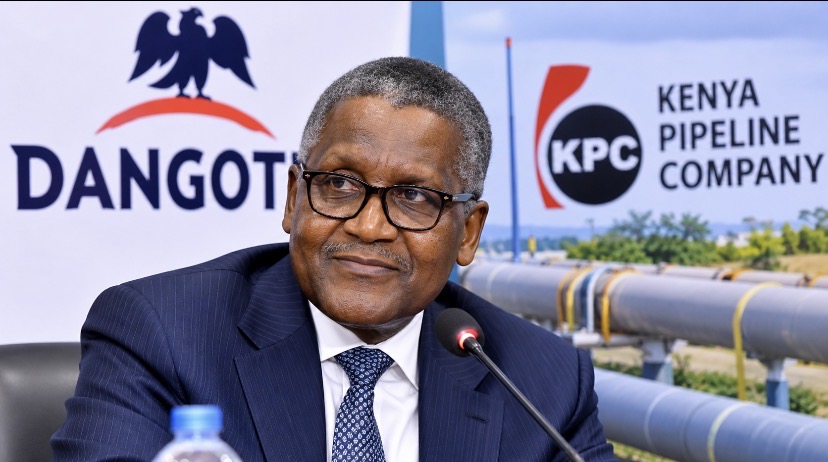
Nigerian industrialist Aliko Dangote has acquired a 24.76 per cent stake in Kenya Pipeline Company (KPC), securing a significant position in the infrastructure used to transport petroleum products across Kenya and to regional markets.
The acquisition extends Dangote’s business interests beyond Nigeria and into a key part of East Africa’s energy distribution system. It also comes as he advances plans for a major refinery project in Kenya, strengthening the connection between his ambitions in fuel production and the infrastructure required to move petroleum products to consumers.
Dangote disclosed the acquisition while attending an event in London. The transaction involved approximately 4.5 billion shares in Kenya Pipeline Company, which is listed on the Nairobi Securities Exchange.
The shares were reportedly purchased from institutional investors, including state-linked funds that had acquired holdings around the company’s initial public offering.
The transaction was valued at approximately 42.5 billion Kenyan shillings, equivalent to about $327 million, according to reports by BusinessDay and other financial publications.
The acquisition makes Dangote one of the pipeline company’s largest shareholders and gives him a substantial interest in an existing energy distribution network.
Kenya Pipeline Company operates infrastructure that transports refined petroleum products from the coastal port of Mombasa towards inland markets. The network is important to the movement and distribution of fuel within Kenya and supports supply routes serving neighbouring countries.
For an industrialist seeking to expand fuel production and distribution across Africa, access to established infrastructure can be strategically significant.
Refineries require more than crude oil and processing capacity to reach customers. Storage facilities, pipelines and distribution networks also determine how efficiently finished products can be moved from production sites to markets.
Dangote’s investment therefore gives his business interests exposure to a company operating an established part of the regional fuel supply chain.
The acquisition also coincides with plans for a proposed refinery in Lamu, Kenya. The project is intended to serve the East African market and could create additional demand for transportation and storage infrastructure if it proceeds as planned.
However, the pipeline stake and the refinery project are separate investments. The acquisition does not, by itself, mean that the proposed refinery has been completed or that its future operations are guaranteed.
Investors respond to the acquisition
The announcement attracted attention in Kenya’s capital market. Kenya Pipeline Company shares reportedly rose by 7.9 per cent on October 22, reaching a high of 9.78 Kenyan shillings after the acquisition became public. The movement reflected investor interest in the transaction and expectations surrounding Dangote’s involvement in the business.
A large strategic investor can influence how the market views a company’s future prospects, particularly when that investor has interests that could complement the company’s existing operations.
Nevertheless, a share-price increase does not establish that the acquisition will automatically improve the company’s long-term performance. Future results will depend on business decisions, market conditions, investment plans and the company’s financial position.
The transaction also changes the ownership balance among major shareholders. Reports indicate that the Kenyan government retained a 35 per cent stake in the company, while Dangote emerged as another significant shareholder.
The precise implications for governance and future investment will depend on the company’s ownership arrangements and any subsequent decisions made by its board and shareholders.
A broader regional expansion
The purchase forms part of Dangote’s wider expansion into African markets, where his business interests have increasingly extended beyond manufacturing into infrastructure, tourism and other sectors.
His energy strategy has particular significance because production and distribution are closely connected. Building refining capacity can increase the supply of petroleum products, but dependable transportation and storage systems are also needed to move those products efficiently.
The Kenyan acquisition provides an entry point into an existing network while the proposed refinery represents a longer-term investment ambition.
For Kenya, the transaction brings a major Nigerian investor into an important energy company. For Dangote, it provides a substantial interest in infrastructure that could become more strategically relevant if his regional refining plans advance.
The long-term impact will depend on how the investment is managed and whether the wider projects associated with his expansion move from proposals to operational assets.
Follow AfriView
Don’t Miss the Next Big Story
Enjoyed this story? Stay connected with AfriView for the latest breaking news, trending stories and important updates from Nigeria, Africa and around the world.