Spain Declares Three Days of Mourning as Deadly High-Speed Train Collision Kills 69
Investigators are examining a possible signalling failure and a decision that allowed a passenger train to continue travelling despite another train being stationary on the same track.
Spain has declared three days of national mourning following a deadly high-speed train collision that killed 69 people and left dozens injured, marking the country’s second major fatal railway disaster in less than a year.
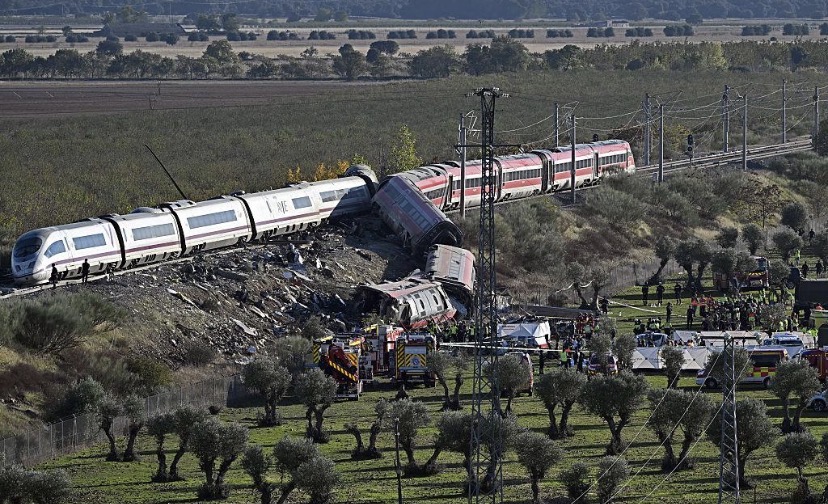
The collision occurred on Wednesday, October 28, near the town of Urda in the central Spanish province of Toledo, when a high-speed train operated by state-owned railway company Renfe struck a stationary train belonging to private operator Iryo.
The impact caused several carriages to derail, with some plunging down an embankment and leaving passengers trapped inside severely damaged sections of the trains.
Emergency services were deployed to the scene, where rescue workers used heavy machinery, cranes, sniffer dogs and other equipment to search through the wreckage for survivors and victims.
The death toll rose to 69 on Thursday after additional human remains were recovered during overnight rescue operations.
More than 50 injured passengers were also reported to be receiving hospital treatment, while families continued searching for relatives whose whereabouts remained uncertain.
The accident has triggered widespread grief across Spain and renewed questions about the safety of the country’s high-speed railway network.
According to Transport Minister Oscar Puente, the collision followed a failure involving the railway’s signalling and communication systems, which resulted in several trains being stopped along the affected section of track.
However, a subsequent decision allowed the Renfe train to resume its journey at normal speed despite the presence of the stationary Iryo train ahead.
The minister described the decision as inexplicable and said investigators would examine how the train was authorised to continue operating under those circumstances.
The precise sequence of events remains under investigation, and authorities have not yet established the complete circumstances that led to the collision.
The two trains involved were carrying hundreds of passengers travelling along the Madrid-Andalusia railway route, one of Spain’s major high-speed transportation connections.
Following the accident, railway services along the affected corridor were suspended as emergency teams worked to clear the wreckage and investigators began examining the site.
The government also mobilised hundreds of emergency personnel, including members of the military and police, to support rescue operations and assist affected families.
Prime Minister Pedro Sánchez visited the area and pledged a comprehensive investigation into the circumstances surrounding the disaster.
He also expressed condolences to the victims’ families, promising that the government would establish what happened and take steps to strengthen railway safety.
Spain’s King Felipe VI and Queen Letizia also visited injured passengers receiving treatment in hospital.
The government announced three days of national mourning, during which flags were lowered on public buildings and official events were cancelled or modified in remembrance of those who died.
The disaster has also intensified criticism of Spain’s railway management, particularly because it follows another deadly train accident in January 2026.
That earlier collision occurred near Adamuz in the southern province of Córdoba, when a high-speed train derailed and struck another approaching train, killing 46 people.
The two accidents have raised questions about the effectiveness of existing railway safety measures, infrastructure maintenance and the ability of transport authorities to prevent human errors from escalating into major disasters.
Railway unions have also raised concerns about investment in the country’s rail network and the need for stronger safety procedures.
Some representatives argue that the focus should not be limited to individual decisions made by railway workers but should also examine the systems and working conditions that allow such mistakes to result in catastrophic consequences.
The latest accident has therefore renewed pressure on Spanish transport authorities to review signalling systems, operational procedures and emergency response arrangements.
Investigators are expected to examine technical records, communications between train operators and control centres, maintenance documentation and other evidence to establish how the collision occurred.
Beyond the immediate investigation, the disaster has highlighted the wider importance of reliable railway infrastructure in countries that depend heavily on high-speed transportation.
Spain has invested significantly in its railway network over several decades, developing one of the world’s largest high-speed rail systems.
However, the latest collision demonstrates that modern trains and extensive railway infrastructure cannot guarantee safety without effective signalling, proper maintenance, reliable communication and strict operational procedures.
For the families affected, the immediate priority remains identifying victims, treating survivors and receiving answers about the circumstances that led to the tragedy.
As the country observes its period of mourning, attention is increasingly turning towards the investigation and the measures required to prevent another disaster.
Follow AfriView
Don’t Miss the Next Big Story
Enjoyed this story? Stay connected with AfriView for the latest breaking news, trending stories and important updates from Nigeria, Africa and around the world.