Flamingos make history, beat Brazil 3–1 to reach first-ever U-17 Women’s World Cup final
Queen Joseph and Awawu Bashiru lead Nigeria to a historic victory as the Flamingos set up a final clash against Japan.
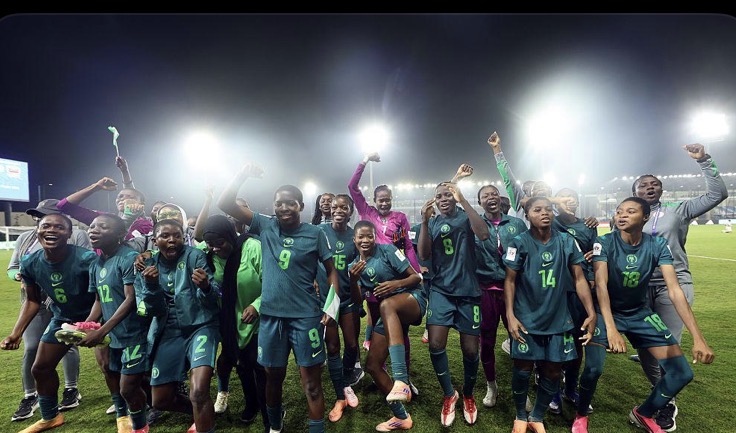
Nigeria’s U-17 women’s national team, the Flamingos, have secured a historic place in the final of the FIFA U-17 Women’s World Cup after defeating Brazil 3–1 in their semi-final encounter in Morocco.
The victory on Wednesday, November 4, marks the first time Nigeria has reached the final of the competition, taking the team beyond its previous best performance of third place in 2022.
The Flamingos produced an impressive second-half display at the Mohammed VI Football Complex in Rabat, scoring three goals to overcome their Brazilian opponents, who had entered the match unbeaten in the tournament.
The first half ended goalless despite Nigeria creating several opportunities. Both sides struggled to find the breakthrough, but the Nigerian team returned after the interval with greater attacking intent.
The deadlock was finally broken in the 56th minute when Queen Joseph found the back of the net. She converted a pass from Oluwakemi Adegbuyi to give Nigeria a deserved lead.
The goal shifted the momentum further in the Flamingos’ favour. Nigeria continued to press, and their efforts paid off again in the 71st minute when Awawu Bashiru doubled the advantage, finishing a move assisted by Joseph.
Bashiru was not finished. She scored her second goal of the evening in the 80th minute, converting a delivery from Oluebube Umejiaku to extend Nigeria’s lead to 3–0.
Brazil managed to pull one goal back in the 89th minute through Greise Kelly, but the late strike was insufficient to change the outcome. Nigeria held on to secure a memorable 3–1 victory and a place in the final.
A remarkable turnaround in Morocco
The Flamingos’ journey to the final has been particularly notable because their campaign did not begin as expected.
Nigeria opened the tournament with a 2–1 defeat to Poland, raising questions about the team’s prospects. However, the players responded with consecutive victories, defeating Puerto Rico 2–0 before recording a significant 3–1 win over defending champions North Korea.
That victory against North Korea was especially important, as it ended the defending champions’ 18-match unbeaten run in regulation time at the competition.
Nigeria finished second in Group B before progressing into the knockout stages, where they defeated Mexico 2–1 in the round of 16. Goals from Oluebube Umejiaku and Mary Dunstan secured the victory.
The quarter-final presented another difficult test against Venezuela. With the match heading towards a possible penalty shootout, captain Azeezat Oduntan converted an 89th-minute penalty to give Nigeria a narrow 1–0 win and a place in the semi-finals.
The victory over Brazil has now completed an impressive run of four consecutive wins following the opening defeat.
Japan stands between Nigeria and the trophy
The Flamingos will face Japan in Saturday’s final, scheduled for November 7, after the Asian side defeated defending champions North Korea in the other semi-final.
Japan secured qualification after a dramatic 1–1 draw in regulation time, followed by a 4–1 victory in the penalty shootout.
The final presents Nigeria with an opportunity to claim its first FIFA U-17 Women’s World Cup title and establish a new milestone in the country’s women’s football history.
Nigeria previously reached the semi-finals in 2022, when the team lost to Colombia before defeating Germany on penalties to claim the bronze medal.
This time, the Flamingos have gone one step further, guaranteeing Nigeria at least a silver medal and its best-ever finish in the competition.
Their victory over Brazil also highlights the progress of the team under coach Akeem Busari, whose players have demonstrated resilience after their difficult opening match.
With Japan now standing between them and the trophy, the Flamingos will be looking to carry their attacking momentum into the final and complete what has already become a memorable campaign.
For Nigerian football, the achievement is more than a place in a final. It is a significant moment for the country’s youth women’s game and an opportunity for a new generation of players to make history on the global stage.
Follow AfriView
Don’t Miss the Next Big Story
Enjoyed this story? Stay connected with AfriView for the latest breaking news, trending stories and important updates from Nigeria, Africa and around the world.